
This year’s list of the world’s 50 Most Marketable Athletes (50MM) is illustrative of the upward trajectory of motorsport right now.
The continued popularity and reach of Formula One is there to see, with ten per cent of the list comprising drivers from the Liberty-owned series, which has one more representative than in 2023 and matches its record number of appearances set in 2022.
Lewis Hamilton, Max Verstappen, Charles Leclerc, and Lando Norris all return to the list after featuring last year and are joined by emerging star Oscar Piastri. It is perhaps no surprise to see that McLaren, Formula One’s most commercially active team, are the only outfit with both drivers inside this year’s 50MM list.
The 1,006 athletes evaluated for SportsPro’s 50MM have been ranked using a methodology devised by NorthStar Solutions Group, which calculates a marketability score for each athlete by combining their performance across the three pillars of Brand Strength, Total Addressable Market, and Economics.
Outside of the top 50, the likes of Carlos Sainz and George Russell were agonisingly within reach of making the list, coming in at 58th and 63rd, respectively.
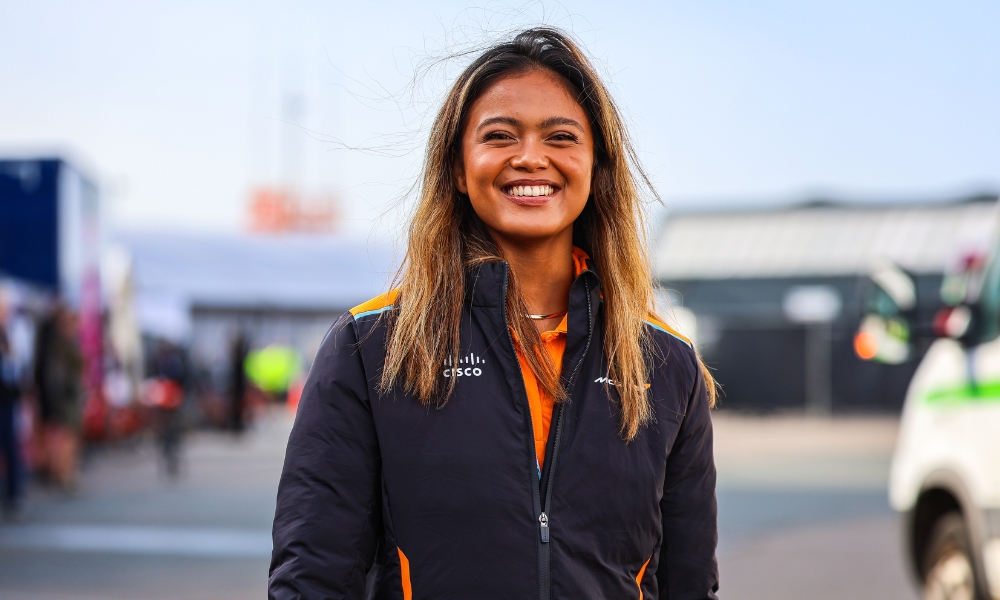
However, eighth out of all motorsport athletes is a surprising name: McLaren junior driver Bianca Bustamante. The 19-year-old competes in the all-female F1 Academy and finds herself just one position behind Mercedes Formula One driver Russell.
This suggests that Formula One’s popularity is also having a halo effect for its associated series, while it also speaks to the growing profile of women in motorsport.
Even so, it’s worth exploring how Bustamante has been able to build her brand with what are still comparatively limited resources.
‘Not a career path that is often pursued’
All but a handful of drivers in Formula One history have been white men – Bustamante is neither of these things. Her upbringing in the Philippines is a world away from the Europe-centric world of motorsport.
“I’m Filipina, I’m from the Philippines, lived there pretty much my whole life,” Bustamante tells BlackBook Motorsport. “Growing up, I was accustomed to the hard work and the difficulties of what it’s like being raised in a country not really known for motorsport, or sport in general to be honest.
“[Motorsport] is certainly not a career path that is often pursued…[but] at the age of three, I started driving a go-kart, and by the age of six I was already competing in national races.”
The Philippines has five permanent circuits, but no major motorsport series visits the country. The archipelago sits in the middle of Formula One races in Japan, China, Singapore, and Australia, but the Asian market specifically is drastically underserved by motorsport.
This is despite the fact Formula One has really strong Asian representation on the grid right now from Japan’s Yuki Tsunoda, Zhou Guanyu from China, and Thai driver Alex Albon. The last three seasons are the first time this century that Asian drivers have driven more than 40 combined races through the year.
At the same time, that statistic highlights that, historically, representation has been poor in the series, especially when Bustamante was growing up. Albon was the first Asian driver in history to reach 100 Formula One race starts at last weekend’s United States Grand Prix.
“I’m proud to be Filipina…I think it’s very important to be proud of where you come from, even though it’s a country that’s not very well known for motorsport,” Bustamante adds. “I’m always very proud to raise it on the global stage.
“There is an essence of responsibility, [being] a role model in every sense because there is a lot of young girls and boys that look up to me.”
Building a fanbase on social media
Bustamante is very conscious of her position as a role model, much of which has been driven by her substantial social platform.
At the time of writing, she has 2.96 million followers across Instagram, TikTok, and X. For female open-wheel drivers, this is unmatched. It’s more than every current Formula Two driver, the second-tier of the junior motorsport ladder. It also exceeds the followings of four current Formula One drivers: Kevin Magnussen, Zhou Guanyu, Lance Stroll, and Liam Lawson.
It’s the quality of her audience engagement that stands out, though. Her Instagram followers are from 20 different countries, which is among the most diverse of any of the top 150 athletes in SportsPro’s ranking. According to NorthStar, her engagement rate on the platform is 10.17 per cent, which puts her 24th in this metric.
Even so, a following of that size brings attention, and Bustamante admits “there are hardships that come along with it”.
“There’s a lot of pressure that I give to myself…you have to make mistakes and fail in the spotlight,” she explains. “It’s not very easy to do, especially as a junior formula driver. I feel like I have the extra added pressure compared to others who can make mistakes and not be seen by the rest of the world.”
After all, social media comes with its own pressures that can be felt by anyone, let alone an athlete pursuing their dreams in the limelight.
“Often we’re blinded by the whole charade of being in Formula One,” Bustamante highlights. “People sometimes forget to see the realness and the human factor that is so important. As a 19-year-old kid, people can easily relate to the struggles.
“I think it’s very important to make mistakes and own up to them…admit that I made a mistake and I’m learning from it, which people can relate to because even the best of them fail.”
Having a large following also means that there is greater scrutiny over everything an athlete does on social media, which Bustamante learned last year, when she had to apologise for liking an ableist tweet about Formula One driver Lance Stroll.
‘I laugh when people say I’m marketable’
It’s important to remember that Bustamante is only 19. Her ranking in this year’s 50MM makes her the second-most marketable teenager in the world behind Spanish soccer sensation Lamine Yamal. The fact she has grown up with social media is something that makes her more relatable to the audience she is regularly speaking to.
“I always laugh when people say that I’m quite marketable, because I guess being 19 I don’t really have a clear picture of that yet,” Bustamante says. “I’ve never seen myself in that way, I’ve always just tried to use social media to share my journey with everyone else…I’m just a kid having fun loving what I’m doing.”
It’s also not lost on Bustamante that there’s a certain irony in the fact her lack of awareness of her own marketability creates an authenticity that brands are keen to associate themselves with. So far, she has by the likes of makeup label Anastasia Beverly Hills and jewellery brand APM Monaco, among other global brands.
“I guess people kind of like [my approach],” she acknowledges. “By the time we knew it, I was working with Google, Cisco, we were on the cover of Vogue.
“Every time that we get any endorsement deals and we get that financial backing, we always reinvest it back into racing. Overall, it goes hand-in-hand – you need marketing to race and you need to race [to attract interest].”
Bustamante knows all too well the financial pressures of motorsport, recalling the days when she had just 1,000 Instagram followers but carried out “five interviews a day to get my name out there”.
“I was knocking on people’s doors,” she adds. “We were emailing all these brands to hopefully work for them just so I could afford to literally test a Formula 4 car, which is close to US$5,000 a day.
“There’s an element of marketability that comes into play when you want to be a professional racing driver…I’m a junior driver who’s still trying to make it up the ladder, and it’s an amazing opportunity that I get to work with all these brands and pursue my dreams.”
‘F1 Academy will succeed because it has good intentions’
Funding, after all, is an issue that impacts everyone in motorsport. Bustamante points to friends who have had to give up their dream due to not having the necessary finances, and it only gets worse the more you progress up the junior motorsport ladder.
“The only way you can ever make it to F2 is financial support when you’re talking about US$2.5 million a year [to compete in the series],” she says. “Where are we going to get that?”
Bustamante currently receives support from both F1 Academy and McLaren for her racing career, but she will not be able to continue racing in the all-female series after this season as she has reached the two-year limit.
The next challenge, therefore, is progression. Some of the initiatives being created in motorsport are inspiring the younger generation, but there is no tangible path for them to progress to the top level of the sport.
“For the longest time I was so drawn to being a Formula One driver, even though I knew it was impossible,” Bustamante says. “I strived hard for it, I shot my shot, eventually I got to this point but there is still a lot of work to be done.
“There always needs to be changes within the sport and outside the sport, all these amazing initiatives - the FIA Women in Motorsport [Commission], Girls on Track, F1 Academy, Discover Your Drive.”
Ultimately, opportunity needs to be given in order for talent to be shown, and Bustamante will have another chance to showcase her ability when she competes in Formula E’s all-female test later this year.
This test will come before the conclusion of her time with F1 Academy, but she is grateful for all the opportunities the series has provided during her time there and she has full faith in the mission behind the initiative.
“I think it’s amazing that [it allows you to] make a career for yourself, even as a woman in sport,” she concludes. “We’re seeing a lot of amazing things happen…the champion of F1 Academy is now racing in FRECA [Formula Regional Championship by Alpine].
“It’s going to be my last year…so I’ll be moving up next year. I’m excited to see where my next challenges are but all in good time. F1 Academy will succeed because it has good intentions.”

Related posts
- Claire Williams exclusive interview: Why she misses F1, watching Williams from afar, and providing opportunities for women
- F1 Academy and Charlotte Tilbury: Why brands need to up their game when it comes to sponsorship
- Diversity, equity and inclusion guide: Tracking the initiatives driving change in motorsport