
Motorsport is an intrinsically commercial sport, which makes marketability a particularly pertinent topic for its athletes.
After all, a large proportion of them must become familiar with recruiting sponsors to fund their junior careers due to the astronomical costs associated with climbing the ladder.
It’s little surprise therefore to see SportsPro’s annual 50 Most Marketable Athletes list feature consistent representation from the Formula One grid. But the 2026 edition, powered by NorthStar Solutions Group, has seen an evolution to the methodology behind the rankings.
Marketability used to be mostly a question of exposure. Today, it is about the relationship between an athlete and their audience – more specifically, how strong it is, which way it is moving, and how much of it is still to come.
These factors are incorporated into the new model SportsPro and NorthStar used to assess an athlete’s marketability, which reads three things together: brand equity (scored out of 45), momentum (out of 40) and commercial trajectory (out of 15).
An athlete’s accumulated brand equity is defined as the trust, reach and commercial standing that define where they are today. Momentum signals the direction and pace of change in that equity; whether attention and engagement are building, and whether brands are moving towards the athlete. Commercial trajectory is a forward-looking measure that assesses the room left to grow – in years, markets, and categories.
Across the three pillars are 27 drivers contributing to the total NorthStar Marketability Score, which determines the final rankings. All told, 1,202 athletes were evaluated across 70 sports, which was whittled down to 247 who were assessed in full, with the evidence window spanning 1st July 2025 to 30th June 2026.
In total, 12 Formula One drivers were fully assessed this year, with three featuring among the top 50 athletes. But who ranked where and why?
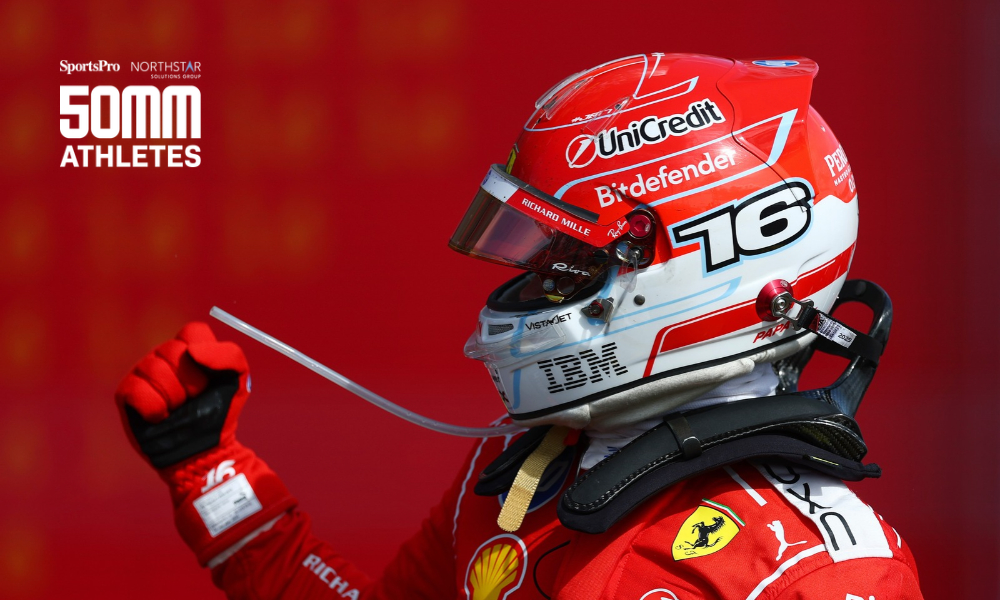
Leclerc wins the battle at Ferrari
One of the major storylines of the 2026 season has been the intra-team battle at Ferrari. Following a less than stellar debut season in Maranello, Lewis Hamilton has bounced back to lead Charles Leclerc in the standings with five races remaining.
Their off-track fortunes, however, have flipped in the opposite direction. Observant readers will note that Hamilton was ranked as the most marketable athlete in the world in 2025 but finds himself in 22nd this year – his lowest position since 2019.
Leclerc, meanwhile, has leapt from 25th to ninth. The evolution of the methodology has seen an increased emphasis on an athlete’s runway to capitalise on their marketability in the remainder of their career. At 41 years old, Hamilton does not have quite as long left racing at the top level as his 29-year-old teammate.
Within the commercial trajectory pillar, Leclerc’s scores for brand base – a measure of the brand strength which future growth can be built on – and monetisation headroom, defined as the brand strength that has not yet been converted into commercial returns, are noticeably high compared to his peers.
After all, his position with Formula One’s most famous team already provides an advantage compared to the rest of the grid. He has 12 endorsement deals under his belt, half of which are already partners in the Italian team’s portfolio. Recent deals include Eight Sleep, Chivas Regal and L’Oreal Paris, adding to his established collaborations with luxury brands like Richard Mille, VistaJet and APM Monaco.
This increased deal activity benefits his recently detected relationships score, which forms part of the momentum pillar, although his overall score in that respect falls some way behind Hamilton’s.
It is brand equity where Leclerc shines, though. His score of 39.68 leads the way in Formula One, with his strongest performing categories being presentation (his recognised personal style and public presentation), attention scale (the size of his audience), and engagement intensity (how actively that audience engages).
“Charles Leclerc has one of the strongest established brands of any athlete in the world,” says Chris Collins, president of NorthStar.
“He ranks second of all 247 athletes we assessed on brand equity, built on how he presents himself, a compelling personal story and premium partners who keep choosing to work with him.”
As one of the most-followed drivers on the grid, it’s little surprise to see his audience scores performing well, but it also emphasises that his followers actively interact with his profile. He also benefits from a high audience breadth score, an expected outcome for all Formula One drivers thanks to their global profile.
Why has Hamilton fallen?
Last year’s most marketable athlete has fallen down the rankings in 2026. It’s a similar story, though, for other legends in their respective disciplines; LeBron James is 26th and Lionel Messi is just one place behind, for example.
Interestingly, despite his age, Hamilton has a particularly high score for recently detected relationships, underlining his continued relevance to brands. The Brit has recently added deals with Lululemon, Fanatics and Perplexity, albeit not during this year’s evidence window.
Hamilton also commands the largest attention scale score in Formula One, while his social cause engagement ranking is understandably high thanks to his work with his Mission 44 charity and his wider diversity work.
What works against him is the sheer size of his brand. He can’t generate much more momentum as he’s maximised his audience, and he can’t offer much in the way of commercial trajectory due to his age.
This is highlighted in his category momentum and audience conversion scores, which translate as the interest in his sport and whether that rising public attention is turning into a growing following. His attention growth is strong thanks to his move to Ferrari, but the underlying theme is that his engaged followers were already involved long before this.
“Lewis Hamilton has the strongest momentum of any driver in the field, and among the strongest of any athlete we assessed, with brands still moving toward him and a purpose-led profile few can match,” says Collins.
“What keeps him below the top ten isn’t his brand, it’s time. At 41, there is naturally less career runway ahead, and a forward-looking assessment should read a great career in its later chapters exactly that way.”
The data even suggests he has potential to grow his endorsements with a good category room score, largely due to his lost deals with Monster Energy, Tommy Hilfiger and IWC Schaffhausen after departing Mercedes.
But there is no doubting that his younger contemporaries have more to offer the new generation of consumers with social-first brands. Indeed, the second-oldest driver to make the top 150 athletes is Pierre Gasly in 91st, who is 11 years Hamilton’s junior.
Verstappen rounds out the podium
Max Verstappen is ranked third of all motorsport athletes and 48th overall.
The outspoken Dutchman does not shirk the opportunity to express his disdain for interviews, PR exercises and social media. He also stepped back from involvement in Netflix’s Drive to Survive docuseries due to his belief that it manufactures drama.
This translates to particularly low scores in narrative strength, media sentiment, and engagement rate momentum. Through this honest approach, however, Verstappen has added weight and credibility to the moments where he works with his partners.
His endorsement credibility score is the highest of all Formula One drivers as a result. His sponsored posts perform almost as well as his normal ones thanks to the fact there’s so few of them, so they don’t feel forced.
His partnerships are also reflective of his personality, acting as an ambassador for EA Sports thanks to his love of sim racing – a love which has also seen him create an official sim racing operation, Team Redline.
There is also a particularly homely feel to his deals, partnering with domestic brands Heineken 0.0 and Viaplay as well as the Red Bull-owned AlphaTauri fashion company.
As a result, the data says his momentum isn’t moving the needle in one direction or the other. His audience conversion score is strong, but his engagement rate momentum is noticeably weak – this ultimately balances out his overall ranking.
Ultimately, being a four-time world champion results in a strong brand equity score – and only Leclerc and Hamilton exceed the Dutchman in Formula One.
But the data also suggests that he is in a position to capitalise on more growth, as seen by the highest cultural foresights alignment score in the sport. This contributes to the fourth-highest overall commercial trajectory score in Formula One.
Where is the world champion?
It will perhaps be surprising to readers that reigning world champion Lando Norris not only missed out on the top 50, coming in at 78th, but ranked behind George Russell (55th) and Oscar Piastri (56th).
His strongest category, commercial trajectory, contributes the smallest percentage to his score. This works against his overall ranking, but it also underlines his high potential to grow in the future.
He has the highest monetisation headroom score of all Formula One drivers, which further emphasises this potential. Plus, his recent moves to become an ambassador for Starburst and to launch his own junior racing team, LN4 Fusion, came after the evidence window.
His attention growth score is also the highest of the drivers. In fact, he scores strongly across all categories associated with reach and audience, which should be expected for an athlete with a social following on his scale.
But the underlying data suggests, beyond his core following, he is not converting new fans (his audience conversion score is low) and his engagement rate score is close to zero.
This translates to a noticeably low brand equity score, but his momentum ranking is comparable to Leclerc and ahead of Verstappen.
“What [Norris] doesn’t yet have is the depth of established brand that Leclerc, Hamilton and Verstappen have built over many years,” says Collins.
“A championship accelerates attention; brand equity takes longer to accumulate. Norris is at the start of that build, with more upside ahead of him than anyone else on the grid.”
Another driver to miss out is the world champion in waiting, Kimi Antonelli. He sneaks into the top 150 athletes at 126th, but the Italian’s momentum score is only behind Hamilton on the current grid.
Add this to the fact he was only 19 when the evidence window closed, and you can expect the prodigy’s commercial trajectory to skyrocket once he has a deserved world championship in his trophy cabinet.