
Sport has wholeheartedly embraced artificial intelligence (AI). And as the most technologically advanced discipline of them all, it’s no surprise that intelligent innovations are transforming motorsport from the garage to the grandstand.
As a perennial technological testbed, motorsport provides the ideal surroundings for proving the effectiveness of AI in a highly competitive environment.
Indeed, the pace of change in terms of adoption, attitudes and development has been relentless since BlackBook Motorsport’s previous investigation into AI adoption back in September 2024.
Motorsport is becoming more sophisticated and considered in how it is using intelligent technologies, especially given the advent of agentic AI and wider conversations about ethics and security.
‘There are times we want to employ AI and times we definitely don’t’
Formula One has been using big data and versions of AI long before such terms entered the technological vernacular. It now has more than six decades of data to draw upon and is collecting a greater volume and variety of real time information than ever before.
This experience of using analytics and this vast, diverse database give Formula One a significant advantage when it comes to adopting AI as well as a compelling motive for adoption. But even so, the series’ AI strategy remains at an exploratory phase.
“Because we are a precision sport, we can’t allow hallucinations,” Chris Roberts, Formula One director of IT tells BlackBook Motorsport last year. “We can’t have things that may be this or may be that – it’s either right or wrong. So, there are times when we want to employ AI and times where we definitely don’t.”
Getting the basics right matters. Nascar appointed Richard Bowman as its first ever director of AI in April to help it get to grips with the nascent technology. He sees short-term efficiencies in areas like internal communications, social media, editorial and HR, with many of the organisation’s challenges similar to businesses in other industries.
Bowman says the widespread adoption of AI in everyday life means that if an organisation is still focussing on how to implement AI, then it is already far behind. Staff will already be using AI, whether it has been sanctioned or not, leading to the risk of ‘Shadow IT’ – the use of unapproved applications for business purposes, a trend which can be a significant security threat.
“The question right now isn’t are people at my company going to be using AI?’,” Bowman says. “The question is ‘are they going to be using it well?’”
Overcoming the connectivity issue
The volume, variety and velocity of data generated in Formula One presents both challenges and opportunities. A new wave of innovations capable of building on existing processes to inform design, testing and strategy now makes it possible to solve the former and seize the latter.
Engineers have long used data-driven simulations to see how weather conditions, tyre wear and other variables can impact performance and final standings. Now AI is helping to make more sense of an ever-increasing amount of real time information, generating more meaningful insights that result in more informed decision making.
Cloud-based infrastructure has been transformative, providing Formula One Management (FOM) and its teams with advanced technological capabilities at any track in the world and reducing the number of staff and amount of equipment that need to be transported. Now it is essential for AI adoption.
But this reliance on remote support and infrastructure has elevated the importance on connectivity. Teams still rely on three or four ‘islands’ of containerised trackside equipment each race weekend and any drop in communication between the paddock and factory can be hugely costly in a sport where every second counts – especially when it comes to AI.
Accordingly, teams are now changing the way they operate to ensure a consistent data environment between the paddock and the factory, adopting multiple communication methods to minimise the risk of an outage.
“The telemetry, the simulation data, relies on one connection – we use two providers in Formula One – but you can imagine this as part of one connection,” explains Fabrizio Pilotti, chief information officer of the Aston Martin Formula One team.
“Then we have special topics that we manage depending on the location. We have two Starlink [satellite internet connections] that help us in covering exceptional cases and then we have the whole 4G/5G and Wi-Fi [networks] that we install at track.”
The result is a seamless operation with extremely low latency which, Pilotti claims, is better than the ten-second delay on the Sky Sports broadcast. All data is sent back to the team’s headquarters in Silverstone where 45 people work in mission control to maximise the possible outcomes.
Tellingly, Pilotti suggests the ubiquity of AI technology has actually meant a lot of teams’ race strategies have converged which has resulted in a significant reduction in the number of unusual approaches to races, such as Lewis Hamilton’s aggressive three-stop at Barcelona this year.
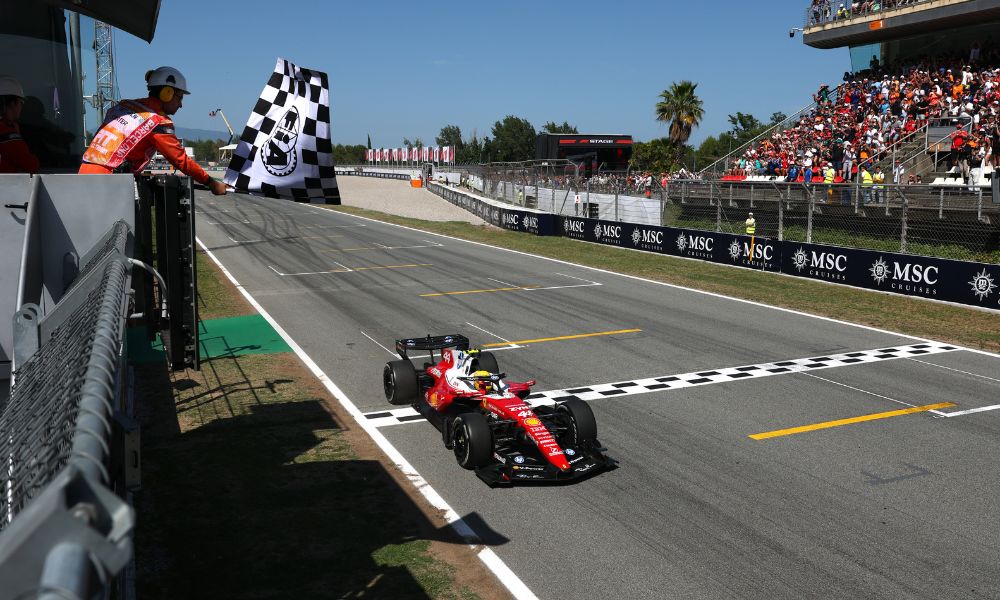
Hamilton won at the Circuit de Barcelona-Catalunya with an unconventional three-stop – but the rise of AI has seen strategies predominantly align amongst the teams (Image credit: Getty Images)
‘We need to close the learning loops fast’
One of the earliest examples of modern technology being used in Formula One is computational fluid dynamics (CFD) software which simulates how physical objects interact with air, making it the primary method for testing the aerodynamic properties of new parts.
Amid rising costs and restrictions on testing – both physical and virtual – AI is now being adopted throughout the design process more widely. Indeed, AI can suggest and test component designs far more quickly and cheaply than conventional methods, revising models at a rate which would simply be too costly, time-consuming or even impossible for humans to achieve.
In terms of how AI affects the engineering workflow at a team, Aston Martin are perhaps a unique example due to the famously traditional and analogue approach from legendary engineer Adrian Newey, who acts as both team principal and managing technical partner.
In fact, Pilotti reveals that both he and Newey share an HP-41C device, which launched in 1979 and helped blur the line between computers and calculators. But AI is still having a noticeable impact on the team’s design process.
Humans stay firmly in the loop for early concept work, and much of this work still happens “in the brain” and on drawing boards. But AI begins to exercise its usefulness once a design exists in computer-aided design (CAD) software.
“From that moment on your data points and you start to do CFD, CFD-surrogate, you’ve got old simulation tools, and then you can heavily rely on sophisticated algorithms, including AI,” says Pilotti.
Digital twins, which are highly accurate virtual representation of a physical space or object, are now commonly used within Formula One to conduct AI-powered simulations. Aston Martin breaks testing down into aerodynamics, kinematics, and tyres and engine power, rather than doing them in bulk.
“We simulate them in different ways because we need to close the learning loops pretty fast,” says Pilotti. “If we are doing aerodynamic research on the front wing, we need to close that one as fast as possible to bring it to track, and sometimes you prioritise that one to the kinematics of the front or rear suspension because of the advantage you see in the simulation.”
Deeper engagement
Of course, Formula One is also a spectator sport whose income relies on broadcast, commercial and event revenues – and that means expanding and engaging the fanbase.
So much of the Haas Formula One team’s time in the spot has thus far been spent trying to keep up with the relentless development race rather than on marketing. AI is helping address this shortfall by streamlining its fan engagement strategy and move towards interacting fans “on a one-to-one basis rather than a one-to-many relationship”, according to Haas senior fan engagement and CRM manager, Michael Heath.
To this end, Haas has launched an AI assistant called RaceMate which engages and responds to fan queries across multiple digital channels.
“This is the way forward: understanding the interactions, the fans, the behaviour, what drives them, what motivates them, and then of course how best to serve them,” says Ante Pamuković, chief revenue officer of Infobip, which designed RaceMate.
“So, you want to be straight to the point, coming to the channels that they use. At the time that they prefer, with the messages that are relevant to them, so without any spamming or additional messages that are maybe not something that you look for, having all this knowledge, filling it constantly in the data profiles of the customers on the CRM.”
Infobip says RaceMate has already seen a retention rate of around 30 per cent with the fans that have used it. And these types of agents are becoming more and more common in motorsport – a similar one was deployed this year by the promoters of the Belgian Grand Prix.
“Our agent, Jack, differentiates itself from a traditional chatbot by pursuing a goal rather than simply answering questions. It understands context, asks relevant follow-up questions, and guides users toward the best decision or action,” says Vanessa Maes, chief executive of Spa Grand Prix.
“For a live event like the Belgian Grand Prix, this is particularly valuable because visitors face complex choices around tickets, hospitality, parking, camping, and travel. Instead of acting as a FAQ tool, the AI serves as a personalised advisor, helping fans plan their experience and reducing friction in the purchasing journey.”
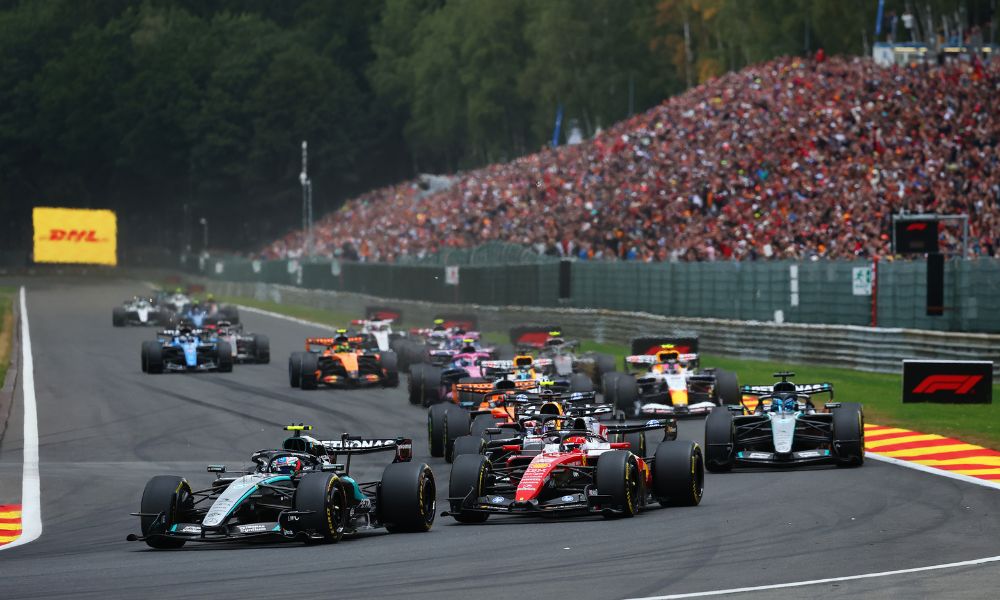
Spa Grand Prix, the promoter for the Belgian Grand Prix, has introduced an AI chatbot called Jack to assist fans on their purchasing journey (Image credit: Getty Images)
Commercial catalyst
AI is, of course, integral to Formula One’s tech partnership with Amazon Web Services (AWS) whose algorithms generate fan-focused insights for its digital channels and broadcast partners.
The relationship epitomises how the series is now, more than ever before, attracting blue chip tech companies seeking a high profile and exciting use case to showcase their wares.
AI is catalysing this activity, with established firms and newcomers seeking to use Formula One to stand out from the crowd and provide tangible, relatable use cases for consumers and businesses.
Examples include Anthropic promoting its Claude chatbot with Williams, Meta AI partnering with Mercedes, and Perplexity signing a driver-specific deal with Ferrari’s Lewis Hamilton.
In fact, Aston Martin has so many AI and tech partners that it hosted a forum at the British Grand Prix.
The event was the largest gathering of a single team’s technology partners in Formula One to date, providing CoreWeave, Zscaler, Cohere, ServiceNow, Cognizant, Cognition, NetApp, Xerox, Arm and EightSleep with the ability to showcase their wares to the media and to one another. In the open era of IT, partnerships between vendors aren’t just desirable, they’re essential.
But much like the technology’s usage in Formula One, AI’s position as a sponsorship category has not realised its full potential yet.
“It is probably still too early to meaningfully measure the effectiveness of AI partnerships in Formula One,” says Camilla Hessey, head of motorsports for Octagon Europe. “What we can measure today is demand: AI is a highly competitive sponsorship category, with a growing number of brands competing for limited inventory.
“The more interesting question is what happens as the category matures. We are already seeing signs of sub-categorisation, which could mean the value of individual AI partnerships moderates over time as teams create space for multiple, non-competing partners within the broader sector.
“However, that does not necessarily mean the category becomes less valuable to teams. Instead, the combined value of several AI partnerships could push the overall category towards the scale we now see in finance, where extensive sub-categorisation allows teams to accommodate multiple partners and maximise the total value of the sector.”
What does the future look like?
Most within Formula One are excited about AI. But that hasn’t prevented some existential dread. Motorsport has always been a fine balance between humans and machines but is there a danger that AI could tip the balance in favour of the latter?
At a time when leading proponents of the AI revolution are suggesting the pace of development should slow down in the interests of humanity, does the competitive tension of motorsport risk being undermined and humans excluded altogether?
In motorsport, this dystopian future is perhaps best visualised by the creation of the Abu Dhabi Autonomous Racing League (A2RL). Instead of using drivers, teams must utilise their coding skills to programme the software in the cars so that these vehicles can perceive their surroundings, make decisions, and race competitively without human intervention.
The category still has some way to go before it can be considered a veritable threat to traditional pursuits, but it also raises questions around the level of AI intervention in modern motorsport.
Formula One, for example, has introduced a complicated set of regulations this season and the new cars require mountains of software to run efficiently. It begs the question: at what point is the driver no longer making a significant difference to the car’s performance?
Motorsport does not exist in a vacuum and many of its concerns reflect wider debates about AI in society. But so long as AI remains an effective booster of performance and revenue without sacrificing everything that makes racing so exciting, expect to see intelligence continue a long history of technological innovation on and off the track.
Richard Bowman will be speaking at the SportsPro AI + Tech conference, which takes place at the London Stadium in London from 29th to 30th September. To find out more about the event, click here.