
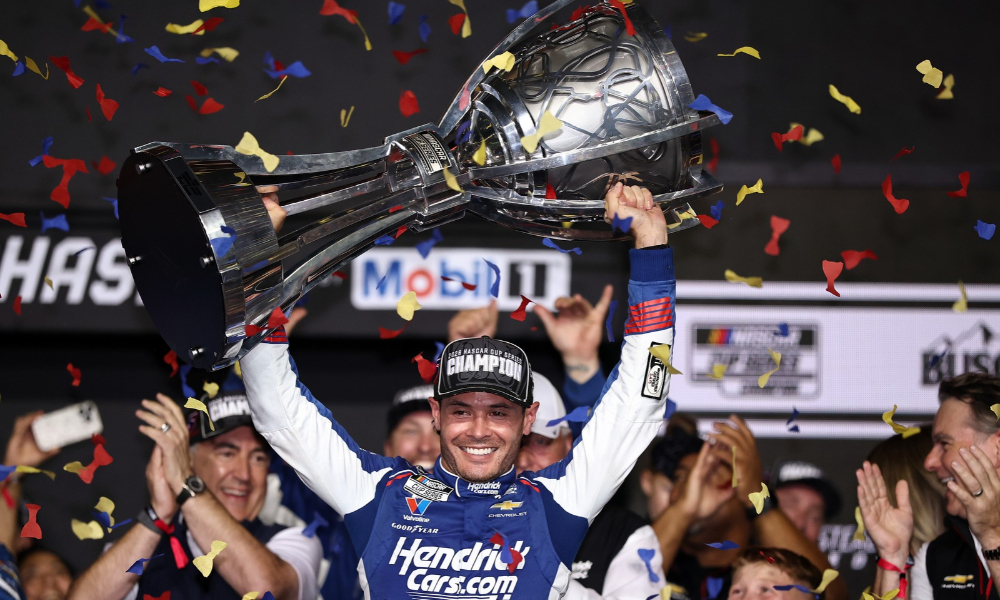
Kyle Larson is now a three-time Nascar Cup Series champion after successfully defending his crown for a second consecutive title.
Though the outcome was the same, Larson’s route to victory couldn’t have been more different – this was the first time since Matt Kenseth triumphed in 2003 that the Cup Series champion was decided before the chequered flag.
That was down to the return of the Chase, the old postseason format used between 2004 and 2013. Since then, a winner-takes-all finale has determined the victor, something which detractors felt manufactured drama and, occasionally, crowned undeserving champions.
Those same naysayers feel the return of the Chase didn’t go far enough. The regular season may carry more weight now, but the driver entering the postseason in first place is reset to just 100 points ahead of the driver in 16th – fewer than two race wins – regardless of the gap at the end of the regular season.
From a ratings perspective, reintroducing a familiar format hasn’t translated to an increase in viewership. Last year, the average postseason audience fell below two million viewers for the first time, but the return of the Chase has not arrested the slide. In fact, the decline has continued.
Viewership ‘a little softer’ in 2026
The hope was that the return of the Chase would reignite interest in the playoffs, but this year’s postseason averaged 1.79 million viewers, a four per cent year-on-year (YoY) decrease. The regular season dipped just one per cent YoY from 2.66 million viewers to 2.63 million viewers.
On the whole, Brian Herbst, chief media and revenue officer for Nascar, tells BlackBook Motorsport that Cup Series viewership “was down two per cent for the year”, describing it as “essentially flat”. But the concern is the NBC portion of the season which, of course, predominantly covers the postseason Chase.
“It was just NBC where we saw their first five races were strong, and then what we saw in the last five or six was a little bit of [softness], so it’s something we pay attention to,” Herbst acknowledges.
The viewership figures for the Chase tell a similar story. The first five races averaged 1.62 million viewers, up 4.6 per cent YoY. The last five averaged 1.96 million viewers, down 10.3 per cent YoY.
Looking at circuits that featured across both seasons, the results were mixed. Darlington, Gateway and Talladega all rose in viewership compared to 2025, whereas there were disappointing results for Martinsville, Las Vegas and Bristol. In fact, four Chase events drew fewer than 1.5 million viewers, twice as many as during the 2025 playoffs.
But it was the championship race itself that provided the clearest example. The Homestead finale drew 2.47 million viewers, down 10.9 per cent from the 2.77 million viewers that watched last year’s title-decider in Phoenix.
“When you see the final numbers, [they] will be a little softer in 2026 versus 2025,” explains Herbst. “A lot of that is because the race [ran] longer last year.”
Over a longer period, though, the trend is harder to explain away. This year’s postseason average is 22.2 per cent lower than 2.3 million from 2024, and 41.3 per cent lower than 3.05 million in 2017.
‘We did not have a target in mind’
Nascar’s logic for restoring the Chase rests on a desire for a fairer sporting format contributing to a stronger business proposition. In short, it’s trying to ensure the long-term credibility of the product after years of final-day shootouts.
“We did not have a viewership target in mind for the Chase when we rolled that out,” says Herbst. “It was more: what’s the right competition format for [the] sport? What’s the right way to crown a champion with all of the competitive integrity that you need to crown the right champion for that particular year?”
The decision was predominantly backed by fans, with Herbst revealing fan sentiment was around 80 to 85 per cent positive leading into the return of the Chase. He also says that teams, drivers, OEMs and sponsors all felt like it was the right way to crown a champion.
But, in the end, viewership did not follow. Herbst argues that traditional viewership is only part of the picture: “[Media] engagement is not just the linear number on Sunday, but the digital and social numbers, we’re seeing those up double digits.”
According to industry reports, there was also growth with younger audiences. Among adults aged 35 to 49, viewership rose 27 per cent across the Chase, and NBC’s three postseason events averaged 455,000 viewers in the 18 to 49 bracket, up 23 per cent.
That younger audience growth will likely be a key contributor to the value of Nascar’s next media rights deal, and Herbst notes that negotiation window is three-and-a-half years away.
‘Our fanbase holds up better on cable than most properties’
The biggest challenge facing Nascar’s postseason has little to do with the on-track action.
Seven of the ten Chase events air on cable, while the postseason also clashes with the National Football League (NFL). These are both significant hurdles to posting strong viewership results.
“We expected there to be a delta between a broadcast race number and a cable race number when we did the deal in 2023,” Herbst explains. “I still think that our fanbase holds up better on cable than most properties.”
Ultimately, he admits that Nascar had to sacrifice reach to secure “the financial numbers that we needed to get the media rights deal done”.
Herbst also accepts that, with the change of format carries greater risk of reducing jeopardy at the end of the season – as played out with Larson’s victory this year. One upside of the winner-takes-all finale was the commercial interest it generated – last year’s race in Phoenix brought in one-off deals with Tide and Krispy Kreme.
There were no such deals this year. To make it more appealing, Nascar might need to be more flexible with its schedule, for example by avoiding clashes with NFL games, and more creative with its marketing.
“The benefit that we have that maybe other sports properties don’t is that we control a lot of this ecosystem from the scheduling perspective, from a programming perspective, race days, times,” he says. “[This is] to make sure that we’re giving our property the maximum opportunity for eyeballs and exposure.”
Herbst also indicates that if Nascar continues to see “some [audience] softness when we go to the NFL season”, that is where the series will focus its attention.
Now that Nascar has committed to establishing a more credible championship finale, the question is whether the series will exercise its control over scheduling to find a creative solution to its postseason viewership woes.