
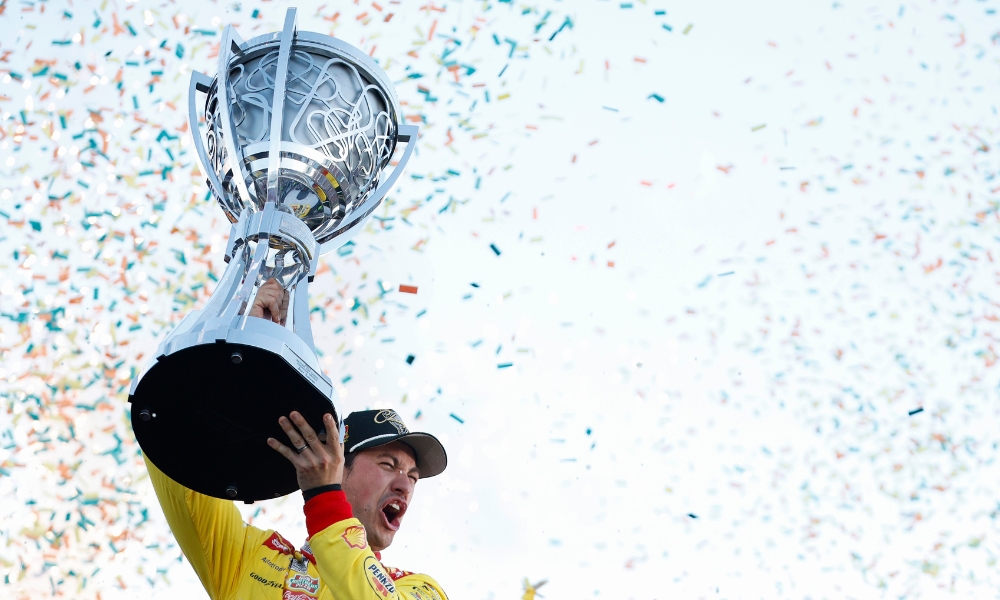
Joey Logano became the tenth driver in Nascar Cup Series history to win three or more championships after his victory at Phoenix Raceway, taking home Team Penske’s fifth title.
The buildup to the championship race was anything but smooth with a controversial outing at Martinsville that saw nine race manipulation penalties handed out in the aftermath. If anything, this was a microcosm of the season at large – and specifically the charters.
Nascar and its teams have not exactly seen eye to eye throughout the prolonged negotiations over the new charter agreement, with the contract eventually signed after two years of disagreements and more than six months on from the original hard deadline.
Even then, Front Row Motorsports (FRM) and Michael Jordan’s 23XI Racing refused the proposal, which has now blown up into a lawsuit alleging monopolistic practices and anticompetitive behaviour by Nascar.
Those on both sides of this deepening divide will hope it doesn’t spill over too far into next year, especially with a landmark TV deal getting underway across four broadcasters.
Nascar is also attempting to market itself as more of an international product, so the in-fighting is hardly contributing to that goal. With a global icon like Michael Jordan lining up against Nascar, it just exacerbates the potential damage for the stock car racing series.
In light of these off-track issues, BlackBook Motorsport analyses the current health of Nascar and looks at how the series is set up for future success if all sides can begin working towards a common goal.
Dented Daytona hides viewership gains
While there may have been various off-track complications, analysing viewership trends remains a comparatively simple way to assess the overall health and direction of Nascar.
On the whole, 2024 appears to emphasise consistency. Regular season viewership rose one per cent year-over-year (YoY) to an average of 3.13 million and playoffs viewership was up five per cent YoY to 2.3 million, but neither figure quite matched the 2022 results (3.28 million and 2.38 million, respectively).
But there is some important wider context to these numbers.
Firstly, and most crucially, the Daytona 500 was severely affected by rain, which meant viewership suffered greatly. This year’s audience of 5.96 million was the second lowest of all time for the iconic race, yet overall viewership for Nascar this season didn’t dip.
The preseason Clash event suffered a similar fate with the race being moved to Saturday due to inclement weather, and just 1.51 million viewers tuned in as a result. Compare that to audiences of 3.65 million in 2023 and 4.28 million in 2022 and the downturn is stark.
Indeed, weather was a particular challenge for the series this season, as Nascar president Steve Phelps pointed out in his State of the Sport press conference prior to the championship finale.
“We had an event, the Clash at The Coliseum, and we were looking at a historic atmospheric river for our event – that’s what they called it – just a lot of rain,” said Phelps. “I think we’ll go with that. So, we did something we had never done before. We pulled a race up a day, and we raced on Saturday night.
“Got crushed in the ratings. Fans didn’t know when it was, how they were going to get there … Saturday’s the lowest-rated day of the week. But it was the right thing to do. It was a financial bath for us, but it was the right thing to do for the industry.
“Go two weeks down the road, and we had more rain. So, we delayed the start of the [Daytona 500] a full day, and we took a ratings bath. So, we were down minus-27. Then we had a rain-shortened race at the Coca-Cola 600, a rain-interrupted event at the Chicago Street Race, so three of your biggest races – down double digits.”
For Nascar’s full season viewership to have matched last year’s figure considering the dramatic drop off in its biggest races is a notable achievement – and particularly promising ahead of a new broadcast deal.
Charting an uncertain course
Nascar steps into its landmark broadcast deal with Fox, NBC, Warner Bros Discovery (WBD) and Amazon on unsteady ground, with a lawsuit hanging over the series after months of wrangling over the new charter agreement.
The majority of teams may have eventually been convinced to sign the deal, but the coalition of FRM and 23XI Racing is taking a stand.
The fact that this involves National Basketball Association (NBA) legend Michael Jordan means that Nascar has to take this particularly seriously, but the rebel teams have already taken a hit in their quest to change the financial landscape in the sport.
A request from FRM and 23XI Racing for an injunction that would allow them to continue competing as chartered entries next season while their lawsuit with Nascar proceeds was rejected by a federal judge on 8th November, meaning the teams face uncertain futures.
Phelps would not be pressed on the ongoing court case, but pointed out that the deal offered to the teams provided a big financial uptick.
“We are not going to negotiate in the media about charters, ever,” he said. “And we are very happy that 32 of the 36 charters were extended because those were race teams that where the deal that was put on the table for them, the primary big win for the race teams was money.
“I won’t go into what the money split looks like, but what I will say is that the amount of money, it now puts the race teams, starting in [2025], as the single largest beneficiary of our media deal. And we did that because the race teams were upside down financially.”
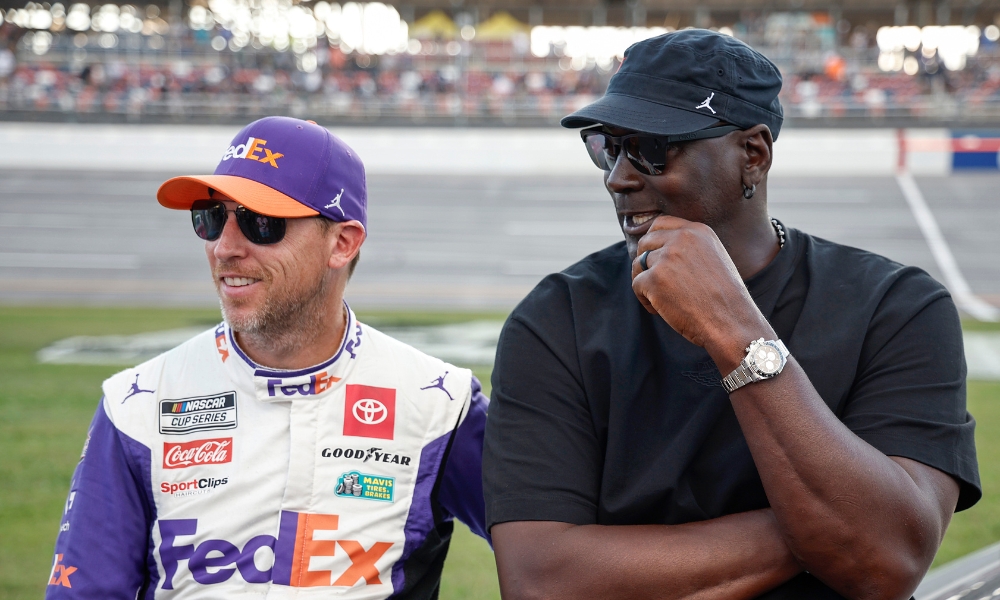
23XI Racing are led by significant owners in current Cup Series driver Denny Hamlin and NBA legend Michael Jordan (Image credit: Getty Images)
While Nascar appears bullish, the legal setback for 23XI Racing and FRM means they both have to reevaluate their position, especially now nothing is guaranteed next season.
23XI Racing’s co-owner Denny Hamlin even went as far as to admit there’s no guarantee that the team will be able to field entries at next year’s Daytona 500.
With the injunction unsuccessful, the teams will have to compete as ‘open’ entries next season. As a result, they are no longer guaranteed entry to races and will earn less than a third of what a chartered team makes for competing in a race.
FRM team owner Bob Jenkins claimed in the original injunction that the payout from the purse would be so low as an open entry that it would not cover the costs of going to the racetrack.
Focusing on the future
Though uncertainty continues off track, Nascar is doing what it can to futureproof itself.
Nascar may not be the first sport that comes to mind when thinking about future-facing properties, but a particular focus on digital and gaming strategies this year could see that change.
The series’ digital platforms averaged nearly six million unique visitors per month in 2024, which marks the sixth consecutive year of growth.
This translated across to Nascar’s gaming ventures as the series saw record-high engagement this year with multiple touchpoints for younger audiences to get involved.
Nascar’s long-running partnership with iRacing is going from strength to strength after 15 years, and the upcoming video game on console should give the series wider reach. Nascar and iRacing also partnered with Playfly Sports this year for the return of a grassroots esports series featuring 300 colleges and universities competing for US$60,000 in prizes.
A collaboration with Roblox on ‘Nascar Tycoon’, which lets players dive into the management and racing aspects of the series, was the most-visited sports brand experience on the online game platform in August, with seven million visits, 40 per cent of which were users under the age of 18.
The series also launched a mobile game with Hutch called ‘Nascar Manager’ that has seen 1.75 million downloads and 23,000 daily active users after launching at the end of last year.
Additionally, Nascar partnered with esports organisation Blast to sponsor both the 2024 Fortnite Championship Series (FNCS) Global Championship and Rocket League World Championship, and became the first sports brand to launch three custom Rocket Racing tracks (Chicago, Daytona, Talladega) in Fortnite ahead of the real-world events.
Most recently, Nascar made its first step into Forza Motorsport, with the Ford, Chevrolet and Toyota cars from this season now all available to drive in the game.

Sustainable expansion
Focusing on the younger generation is great for Nascar’s future, but tangible building blocks need to be put in place now to ensure the series is reaching audiences around the world, not just in the US.
Of course, Nascar is not just the Cup Series and the wider brand held races in 12 countries on three different continents in 2024. The series is broadcast in 185 countries and territories, and there are currently four international series in Mexico, Canada, Brazil and Europe.
The Nascar Mexico Series actually opened the Cup Series season by racing at the Los Angeles Memorial Coliseum as part of the Busch Light Clash weekend.
Mexico is a particular point of focus for Nascar at the moment after it secured a race in Mexico City next year. This will be the first international Cup Series points race in the modern era of Nascar, emphasising that the series is trying to do things differently.
The stakes just got higher at one of our most exciting tracks.
— NASCAR (@NASCAR) May 15, 2024
TNT Sports' broadcast coverage and the 2025 In-Season Tournament begin at @ATLMotorSpdwy. pic.twitter.com/2QAStq0ePQ
Another point of difference for next season will be the bracket-style in-season tournament, inspired by a similar concept introduced by the NBA last season. The tournament offers a US$1 million prize and will be shown across Prime Video and TNT Sports, the newest arrivals to the Nascar broadcast scene.
The big issue facing Nascar on the media front as it heads into 2025 is ensuring fans are well-informed on the broadcast schedule.
Practice and qualifying will be shown by Prime Video in the first half of the season, excluding the Clash, the Daytona 500 and the All-Star Race which will all air on Fox. The sessions in the second half of the year will be broadcast on TNT Sports.
For the races themselves, 14 are on Fox, followed by five each on Prime Video and TNT Sports, before NBC rounds out the year with 14 events.
The second-tier Xfinity Series leaves the package completely with all 33 races to air on The CW, while the Craftsman Truck Series will get full coverage on Fox’s pay-TV channel FS1.
Confused? Nascar needs to make sure that viewers are not. Teething issues must be kept to a minimum to guarantee fans stay onside at the start of this new broadcast relationship.
Related posts
- What’s going on with Nascar’s charter system?
- Nascar’s US$7.7bn TV deal: Why the annual value went up, who gets what, and the impact on fans