
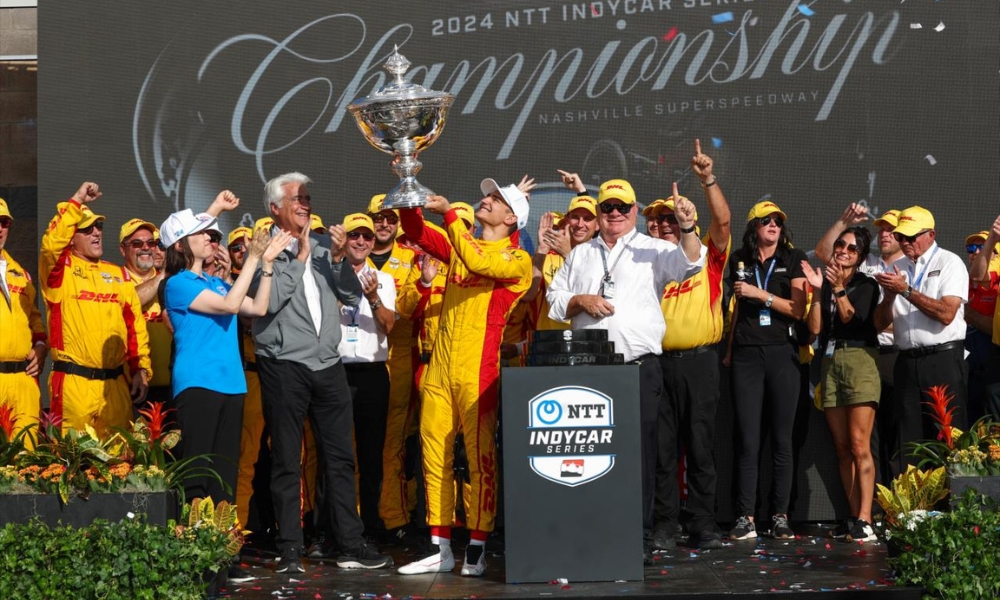
The final IndyCar season aired by NBC has come to a close, with Fox waiting in the wings to kick off a new era for the North American series from 2025.
Álex Palou made it three IndyCar titles in four years at last weekend’s season finale in Nashville, but the Spaniard will hope the series’ off-track revolution doesn’t result in an on-track shakeup that disrupts his dominance.
Moving on from a 16-year broadcast partnership with NBC represents significant change for IndyCar, but Fox has committed to full network coverage of the series. Including qualifying for the Indianapolis 500, there will be 19 windows of race coverage on the network’s flagship channel next season.
However, despite the 2023 season being the most-watched IndyCar campaign since 2011, momentum seems to have stalled this year. There appears to be some tension building behind the scenes, too.
The impending adoption of a charter system has not been met with universal approval, with team owner Michael Andretti calling on series owner Roger Penske to sell IndyCar at the beginning of the year.
While IndyCar retains a healthy partnership portfolio, new sponsorship agreements have been scarce this year. From a technical standpoint, a midseason switch to hybrid engines seems to have had a negative impact on the racing action.
As IndyCar looks ahead to 2025, BlackBook Motorsport analyses the off-track talking points from this season to evaluate the health of the series going into next year.
Olympic-hit viewership figures
After experiencing record viewership in 2023, it was expected that IndyCar’s momentum would continue into this year. But a disrupted season is one reason that those forecasts haven’t come to fruition.
Viewership figures for the last eight races of the campaign are still to be published and, at the time of writing, IndyCar has not responded to requests to release race-by-race information. The last exact figure to be shared with the public was for Mid-Ohio in early July, when an average of 1.25 million people watched Arrow McLaren’s Pato O’Ward take victory.
An IndyCar spokesperson told BlackBook Motorsport the series is averaging over one million viewers per race and that it is still tracking close to last year’s audience delivery. The series is also reportedly seeing gains with the 18 to 34 demographic, but there are no specific statistics.
There are still questions left unanswered because, outside of the Indianapolis 500, which reached a record cumulative audience of 13 million viewers, Mid-Ohio is the only race known to have exceeded one million viewers this season. Seven races delivered a nine-figure audience in 2023, which highlights the drop-off in 2024.
More often than not, a lack of viewership information comes down to a series not wanting to release the statistics, rather than not being able to. But in defence of IndyCar, some of these challenges are not of its own making. The 2023 season was the most watched since 2011 largely because 13 of the 17 races were broadcast on commercial television, which was just the fourth time in the last 50 years that this has happened.
This season, NBC reduced the schedule of races on its main channel to just nine as the broadcaster chose to give priority to other sports properties that sit within its vast media rights portfolio.
IndyCar even took a midseason break from racing this year due to the disruption caused by NBC’s coverage of the Paris 2024 Olympic Games.
In this context, it’s clear why IndyCar opted to side with a broadcaster that wants to make the series a priority for its next deal. Even so, viewership will need to bounce back quickly on Fox to make this move a success.
Public spats and teething issues
In many ways, securing the broadcast deal with Fox was a much-needed positive news story for IndyCar. Reports suggest the contract could be worth at least US$25 million a season, which would be US$5 million higher than the deal with NBC.
The story was ‘much-needed’ due to various off-track incidents throughout the year.
Michael Andretti’s public outburst towards Roger Penske was fuelled by his belief that Penske was not investing enough money into the series. Andretti called the attempts to adopt a charter system “comical”, but it’s important to remember that Penske – a veteran of IndyCar – practically saved the series from extinction during the pandemic. He also invested US$17 million in marketing the series in 2023.
The series can’t stand still, though. With Formula One finally offering some competitive action, IndyCar’s USP is being challenged. Worse still, the predictably unpredictable IndyCar racing has gone somewhat stale since the introduction of hybrid engines.
Ultimately, the cars are now heavier, which makes it harder for drivers to overtake. There have also been questions around the impact of the technology at IndyCar’s oval races, as the regen aspect is rendered largely null and void with occasional lifts and little-to-no braking.
Those concerns were compounded at Iowa Speedway, where there were no on-track passes for the lead across two races, although a track repave also contributed to the lack of competitive action.
It should be noted, though, that attendances have improved this year and were sitting at ten per cent higher than 2023 prior to the season finale in Nashville. Naturally, the Indianapolis 500 again delivered the largest single-day spectator sporting event in the world with more than 330,000 fans in attendance.
Adjusting the on-track product will provide the foundation for future growth in IndyCar. After all, the series does not benefit from the sizeable following of a series like Formula One, which leveraged driver personalities to promote itself at a time when it could only offer processional racing.
What are the priorities moving forward?
IndyCar’s off-track uncertainty also appears to be having an impact commercially. Major deals have been few and far between in recent months, with Cisco the only significant new sponsor secured in 2024.
Despite that, the series did get some renewals done early, including with American Medical Response, Molson Coors, NTT, and Sonsio, whose extensions came into effect this season.
Just prior to the season finale in Nashville, IndyCar also secured a multi-year extension with long-time tyre supplier Firestone. Overall, though, it’s been a quiet year for the series on the sponsorship front.
It makes sense, then, that the series is already working on how it can expand its following in the future. It will hope that the addition of Prema Racing to the grid in 2025 will attract a more international audience, with the Italian team set to enter two full-time cars in partnership with Chevrolet, although it will not initially be eligible for a charter.
Related posts
- IndyCar CEO Mark Miles on the Fox media rights deal, expanding into new markets, and plans for an international series
- IndyCar’s TV deal with Fox: Why has the series left NBC and what does the move mean for its future?
Attracting that global audience has always been the challenge for IndyCar. A fleet of international stars like ex-Formula One drivers Romain Grosjean and Marcus Ericsson should encourage wider interest that has not previously been forthcoming. Plus, 26 of the 43 drivers to have competed this season originate from outside North America, which should help drive intrigue in new markets.
But there is one particular North American driver that should be the focus for IndyCar right now: Pato O’Ward. The Mexican is undoubtedly the most popular driver in the series, but IndyCar appears reluctant to capitalise on his profile.
To highlight this disconnect, IndyCar chief executive Mark Miles recently claimed that O’Ward “isn’t as famous as the last previously famous Mexican driver [Adrian Fernandez]”, a remark that has been widely questioned by media, drivers, and fans.
Was the IndyCar boss downplaying O’Ward’s popularity after Nascar confirmed Mexico City on its 2025 schedule? That’s certainly one interpretation worth considering, especially as IndyCar so often plays second fiddle to the stock car racing series. A race in Mexico would have been a clear differentiator in that respect.
Moving first will be key in the future, otherwise a reluctance to evolve could leave IndyCar trailing in the wake of its competitors.
