
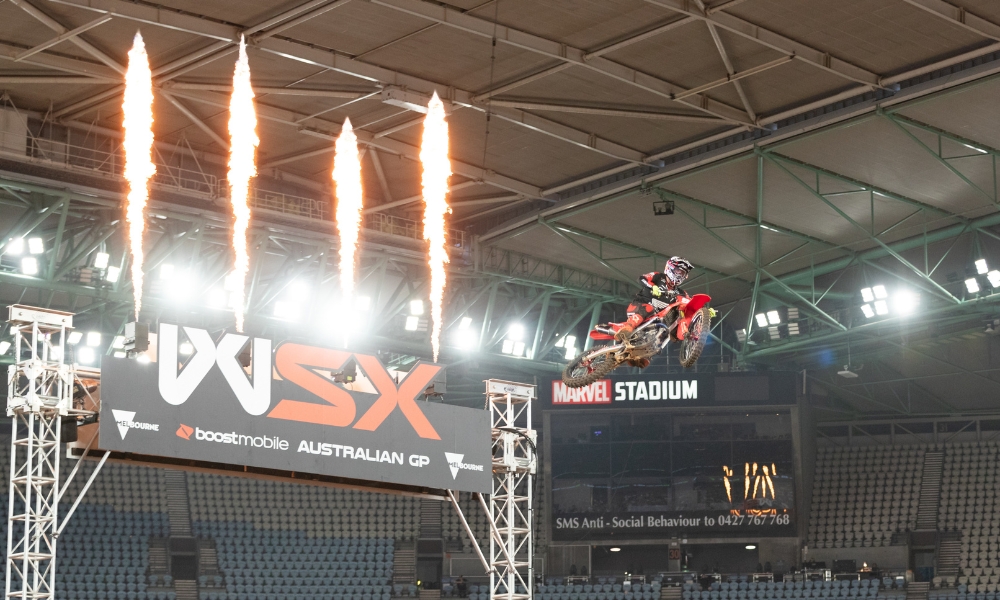
It’s certainly an intriguing time to be involved in two-wheeled motorsport after Liberty Media moved to acquire MotoGP.
While it will likely take until at least November for the takeover to be approved, it brings extra attention to all forms of motorbike racing around the world.
Within the many sub-sections of two-wheeled racing is supercross, a variation of motocross. The latter takes place on off-road circuits, but the former modernised the format by bringing it to sports stadiums.
Providing greater accessibility for fans helped this variation of the sport to become the premier form of off-road motorbike racing, especially in the US. However, the hierarchy of these series is complicated.
In 2022, the World Supercross Championship (WSX) separated from the American Motorcyclist Association (AMA), which sanctions the major US-based AMA Supercross Championship.
The latter series held world championship status until the split, at which point the world championship moniker transferred over to WSX under the International Motorcycling Federation (FIM).
Having lost the world championship title, the AMA and Feld Entertainment, which owns the AMA Supercross Championship, created the SuperMotocross World Championship. This combined the aforementioned supercross series with the AMA Motocross Championship.
Meanwhile, WSX has navigated its fresh start under its new promoters, Australia-based SX Global. It’s been far from smooth sailing, though, as SX Global was sold to an investment group after just one year.
This group, led by Kyril Louis-Dreyfus and Juan Sartori, the co-owners of English soccer club Sunderland, has steadied the ship. This became clear in May this year, when the FIM agreed a new ten-year deal with SX Global to continue promoting WSX. Running until 2033, the contract also includes the option of an additional decade.
With solid foundations in place, the series appointed a new chief executive, Tom Burwell, to usher in the new era of supercross.
BlackBook Motorsport sat down with the former director of business development and sponsorship at Formula One to learn more about his plans for the series, how it will cut through in a cluttered market, and his hopes for future growth around the world.
You’ve been in the role for a few weeks now, but how quickly did conversations progress around this opportunity?
So I met with ownership about eight weeks before I started and the process has very much been one of alignment.
If you look at WSX as a sporting asset, and you look at the platform that is being built by the ownership, it was engaged conversations about opportunity in the future and where we saw this going, both as a sport and as a platform, and then how that fitted into their wider ecosystem.
Ensuring there was full support for a vision for that sport, and it being very much a long-term vision, [that] was important for me. [I’m] appreciative of where we are currently, but ultimately [we’re not] where we want to be and [it’s about] understanding that that’s a journey [to get there] rather than an immediate knock on a door and suddenly it’s fixed and ready to go.
I think we all know that different owners have different reasons for being in the space, so those conversations are very much about alignment in what I wanted to achieve, what I thought was realistic to achieve [in the right] timelines, and the support that would be needed to do so.
[We’re] really fortunate that we’ve got an ownership group that is very supportive of that and really forward thinking on what this opportunity is for supercross in the global space and outside of the US.
Those owners are obviously well-known for their work with Sunderland. How much did that influence your decision?
I think it’s fair to say Kyril and Juan are exceptionally forward thinking as sports owners. They are methodical in their approach; it’s not spend freely, it’s let’s build long-term structural foundations and plans, and then let’s be innovative with how we speak to consumers and partners and those within the ecosystem.
If you are going to have private ownership, which we’re lucky that we have, it means that you’ve got dynamism in your decision-making processes. Equally, you’ve got to make sure that the private owners have real alignment with me as an operator, otherwise you’re going to run into challenges before you even begin.
So it was actually just two really solid private owners that have got experience. Juan’s obviously heavily involved in Monaco Football Club, so [he’s] really experienced in the football space, looking at other sports acquisitions, and ensuring that alignment piece was the most important.
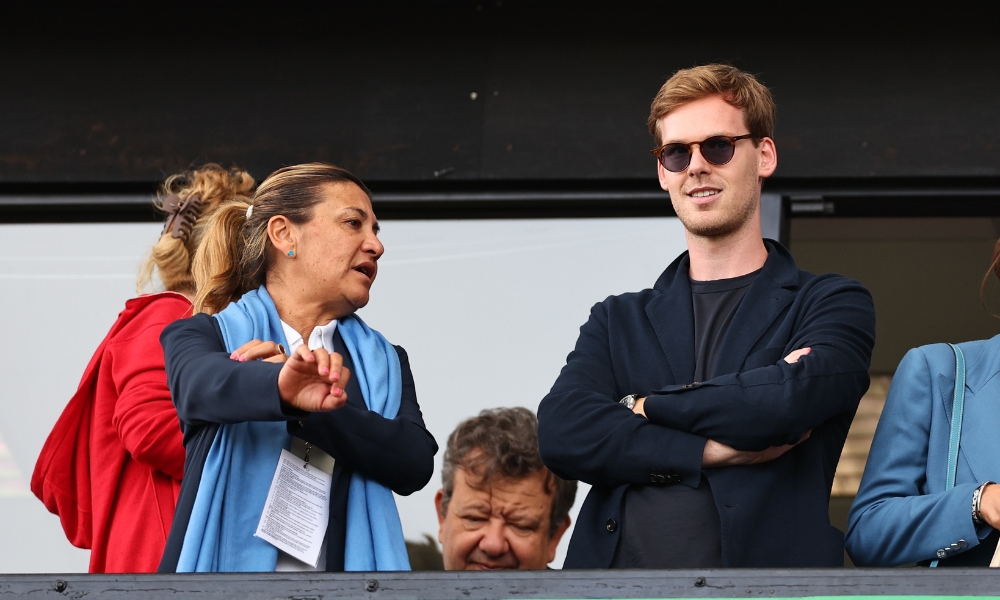
Kyril Louis-Dreyfus (right) is known for his work with Sunderland, currently competing in English soccer’s Championship
When you looked at WSX as a property, what stood out to you as the main growth areas?
It’s a product which lends itself so well to both digital and at-event experience. In many ways, it’s been under-developed in a lot of the non-live areas especially. The live experience is so visceral that it doesn’t matter whether you’ve never watched a race or understand the rules, you’re going to have a great time.
The idea that it can be [shown] in a two-hour broadcast window, that’s a three-hour window as a live experience, and we know that’s a real sweet spot for engagement for fans, both as a TV product and a live product.
And then there’s this digital-first Gen Z space, which lends itself to hero moments. Those hero moments are not necessarily just overtakes, it’s what’s happening in the air, what’s happening on the jumps.
There’s a relentless nature to that that can be clipped up and repackaged and put out in a digital-first consumption space. I don’t think [WSX] has been truly exploited, so my excitement around it was that’s where I think we can be.
We haven’t had the opportunity to invest and develop that platform and that product. [WSX] has traditionally been looked at very much like a disparate group of events, rather than a true global platform that looked at it global first, zooming into local – rather than local first, zooming out to global.
It’s early days for you, but have you identified any major challenges for the series?
If we’re going to be successful in what we’re doing, and in line with the ownership’s vision, we have to do exactly what we say we’re going to do. In 2024, we’ve got four races across three countries: we need to deliver those at a world-class standard, with world-class rider quality competing for a world championship.
We’ve got a small window to do that but that’s almost non-negotiable. If we don’t deliver that in 2024, I think it’s very hard to sell against that for 2025 and, ultimately, you go into a point of flux and you’re just going to say the same things.
The challenge to us in the team is that is the non-negotiable as we go from where we are today to absolute world-class delivery across those venues, with those riders, with those teams, because we don’t have the manufacturer support in the way that supercross does in America.
To do that, we need to build the platform that means that manufacturers and stakeholders want to come and engage with [us]. We really just need to do exactly what we say we’ll do, which is deliver world-class events.
The challenges [that follow] are much easier conversations and opportunities because we have an evidence-based approach for why people should come and get involved.
You were heavily involved in securing the new Madrid race for Formula One. How will that experience help you in your new role at WSX?
Formula One is in an incredibly fortunate situation that it’s able to communicate with prospective new hosts and owners around the world in a really immediate fashion. Nobody doesn’t know what Formula One is.
I think when WSX goes to market and into certain new audiences, and certainly when it begins to engage with governments and cities and potential promoters, we’ve got to do more work on who we are and what we are and how that aligns with certain race markets.
Clearly it would not be fair to make direct comparisons because the reality of the audience the two are drawing is very different, and WSX is much more of a challenger sport.
The other bit is that WSX, in many of our markets, act as the promoter as well. So we may be engaging with cities, but we’re also then taking the financial risk to sell tickets ourselves. We’ve got to be much more zoomed into the local market and the legacy impact that we have in the local market, knowing that we will return a year later with risk again.
Other rights holders are obviously much more at the global level and they can be much more of a moving circus, that’s the fundamental difference.
Related posts
- Liberty’s €4.2bn MotoGP takeover: Answering the key questions and what it means for F1
- How electric motorcycle series E-Xplorer plans to build the “Amazon for two-wheelers”
How important is being granted world championship rights until 2033 to the long-term security of the series?
Dorna didn’t develop MotoGP into the asset that it is for Liberty’s investment overnight, it took a long period of time. Infront [Moto Racing’s] development of MXGP [Motocross World Championship] has taken a long period of time so that they’re now racing in 20 markets around the world and really successful with it.
If we look at it as a short-term view, whether that’s with ownership or the licence with FIM, whilst we’ve got pressure to make sure we’re delivering world-class events and we have a [profit and loss] that we’re accountable to, you’ve got to look at that as a long-term [plan].
This is with regards to building value in a sport and growing fans, and how those audiences might come in at certain ages and at what point you’re able to monetise them. Those things don’t happen in [a few] years, those things happen in [as much as] ten years.
To have the security of where we are with the FIM licence is really important, because we can then go on that journey with FIM and our promoters and our cities around the world. [It also helps us to] engage cities on mid-term length deals knowing that they’ve got the comfort that that’s where our commitment is to the sport.
What needs to happen over the next five years for you to consider it a success?
We’ve got to conservatively grow year-on-year, and that is at host city race level. So let’s say we’re four races this year, I think we should be six races next year and then we can continue to grow conservatively in the markets that we are strategically highlighting.
We need to invest in our global platform so that it’s truly a global sport that we’re talking about. We have a responsibility as the platform itself that all those that come into our ecosystem are given value.
Whether that’s fan-first in our product, whether that’s manufacturers engaging with and supporting the teams, whether that’s riders, however that is we have to build value.
Success looks like – I’m reticent to say an arbitrary number – but a number that is two times from where we are now. So let’s say around ten races around the world and a global platform which is very clear [about] what is WSX.
It’s recognition that our world champion is recognised across the sport as the world champion in supercross. I think that is a really important part of who we are and getting that cut-through across the sport.
I think global partners that have come on that journey as well, if we’ve been successful at building that platform and taking it to new audiences, then instead of partnerships being local-first and truly endemic, we’ll be in a non-endemic space with partners that value our global platform.