
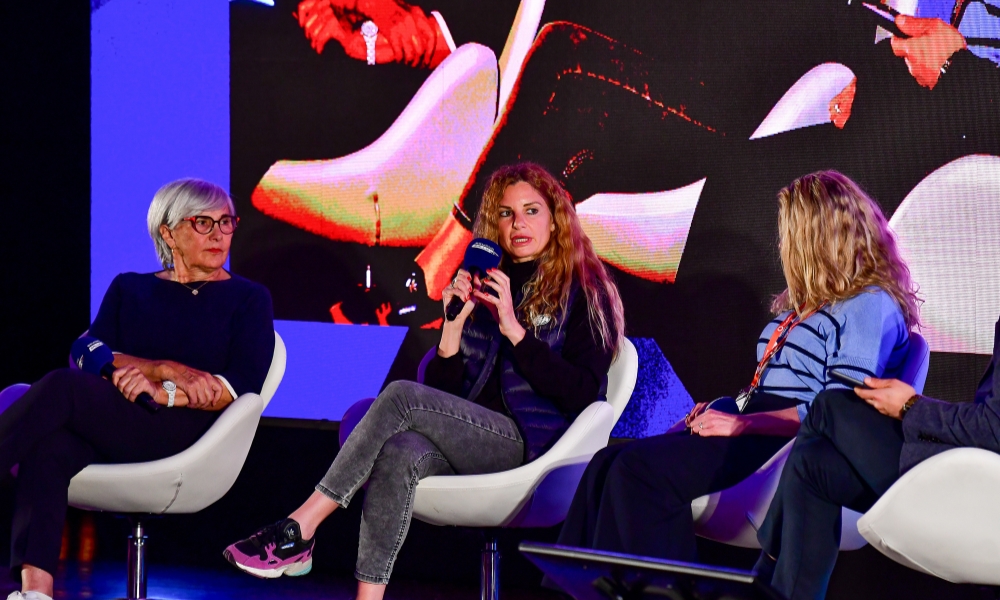
The Beyond Rally forum returned for its second edition on 9th May ahead of the Rally de Portugal.
Organised by the World Rally Championship (WRC), the International Automobile Federation (FIA) and the Automotive Club of Portugal (ACP), the aim of the forum is to drive sustainable development through rallying.
This year, it coincided with the release of WRC Promoter’s Sustainability Roadbook, which lays out the long-term strategy for the rally championship, promotes the sustainability initiatives being carried out by the series, and seeks to engage stakeholders in pursuing sustainable progress.
Motorsport is past the point of turning a blind eye to its environmental impact. And Portugal was a fitting setting for the WRC event to highlight some of the challenges, with coastal erosion, water scarcity and increasing temperatures all very real issues facing the country.
Portugal is also well-known for its population of eucalyptus trees, but it is an invasive, quickly regenerating species that is highly flammable, exacerbating the risk from potential wildfires.
Events like Beyond Rally, and the Rally de Portugal itself, are crucial in raising awareness and ensuring the appropriate steps are being taken towards tangible progress.
Against the backdrop of these issues, BlackBook Motorsport picks out the key takeaways from WRC’s sustainability-focused conference.
Asides from the fierce competition on the stages, the #WRC provides some of the most challenging environments in the world for brands to test products that will lead to a more sustainable future.
— World Rally Championship (@OfficialWRC) May 11, 2024
Learn more about this work here
Motorsport is a testbed for future technologies
Motorsport has always served as a platform for new technologies, especially when it comes to road-relevant series.
While motorsport leads the way for automotive technologies, it must follow the direction of the automotive industry to remain relevant. A ban on the sale of new diesel and petrol cars is coming in 2035 in the UK and the European Union (EU), so many motorsport series have started to take action to get ahead of this change.
WRC, for example, introduced 100 per cent fossil-free fuels for its cars in 2022, making it the first FIA series to do so. Achieved in collaboration with its partner P1 Fuels, the move highlights the potential that motorsport has to push wider society towards sustainable progress.
This is important as, even with the incoming ban in 2035, combustion engines will not cease to exist. Finding a way to adapt this old system with new technology for a sustainable future is essential.
Looking at the work P1 Fuels has done with WRC, the progress is impressive. The company’s partnerships with various series have enabled it to carry out the necessary experimentation to create the first helicopter flight powered entirely by fossil-free fuels.
P1 Fuels also carried out zero modifications to the original engine, highlighting the importance of a drop-in solution. Silver bullets are rarely this simple but, with the 1.5-degree global warming threshold likely to be breached before 2030, motorsport can play a vital role in highlighting the feasibility of low-carbon fuels.
The next step is ensuring that the price point of sustainable fuels becomes more accessible for the everyday consumer so that change can begin to be meaningful.

P1 Fuels’ chief executive Martin Popilka detailed how experimentation with WRC has accelerated the real-world implementation of more sustainable technology
‘We’re lost when it comes to biodiversity’
This was a refreshingly honest statement from the FIA’s head of sustainability Barbara Silva that highlights where motorsport currently stands on biodiversity.
There is sufficient experience within motorsport’s stakeholders to address issues linked to climate change. Much progress is still required, but the knowledge on how to measure it and knowing what needs to be done is there.
Biodiversity is the next challenge that motorsport must get to grips with. There isn’t time for people to spend years getting their heads around this issue.
Ultimately, the FIA is full of sustainability professionals, but not biologists that specialise in biodiversity. At the same time, it is the responsibility of the governing body to provide accurate guidance to its stakeholders.
- Exploring the revamp of WRC’s Rally.TV, ‘the home of offroad motorsport’
- WRC and DAZN sign eight-year global distribution deal for Rally.TV
The FIA is working with the International Union for Conservation of Nature (IUCN) to try and make suitable progress in biodiversity. It is pivotal to understand the relationship with nature and how motorsport affects habitats.
That’s not to say motorsport isn’t already trying to mitigate its impact, something that WRC has already taken steps towards. Each of its events is designed to have the lowest possible impact on the local environment. Every road after every stage is cleaned to ensure no rubbish is left behind, which is just one of many processes in place.
WRC also has ‘eco marshals’ at every event, who not only identify potential incidents, but engage with the public that attend to further the conversation around sustainability.
The rally championship is also the first motorsport series in the world – and the second sporting organisation – to pledge to protect UNESCO World Heritage Sites.

Barbara Silva, head of sustainability at the FIA, revealed that biodiversity is the next great challenge that motorsport must face
Lowering barriers to entry for women
WRC does not struggle for female co-drivers – there are multiple across the WRC2 and WRC3 junior categories – but the championship is aware it can do more to promote women as main drivers.
As with many motorsport series, women have historically been failed by a lack of opportunities, but WRC Promoter is taking steps to ensure that it can tackle the issue quickly and effectively.
This year, WRC is launching the Women Accelerator programme, an initiative that could do a lot for creating more opportunities for young women looking to get involved in rallying – even if rally legend Michèle Mouton, arguably the most successful female driver in motorsport history, suggested a name change.
Mouton and former rally drivers Burcu Çetinkaya and Pernilla Solberg shared the sentiment that they were never focused about being the fastest woman. Rather, they wanted to be the fastest driver. However, they also acknowledged that motivation alone was not enough.

Michèle Mouton is arguably the most successful female racing driver of all time, achieving four rally wins and a second-placed finish in the 1982 WRC drivers’ championship
Lowering the threshold for entry is crucial for creating an environment in which men and women can compete as equals. This cannot be a box-ticking exercise, though, and none of the ex-drivers on stage wanted performative activism. They would rather one great female driver competes in WRC than many poorly performing ones.
As part of the Women Accelerator programme, 15 young female drivers will take part in a test and the best three performers will debut in the Central European Rally in WRC3 this year. This isn’t a hopeful plan with vague deadlines – it is looking to make an impact immediately.
Pointing to influential figures like Monisha Kaltenborn, Leena Gade and Susie Wolff, Mouton closed with the reminder that a woman with the drive to succeed in motorsport will do so.
Increasing the available opportunities through this WRC programme will only serve to level the playing field.